← Back to the front page
Rules & information

Every rule and the whole points system.

Our leaderboard uses a dynamic zero-sum system — every ball, every rally and every game counts. Below you can read about the points matrix, the different formats and how the club's tournaments are run.

These are exactly the same rules as under Rules & information in the app.

Zero-sum

The points system

Every new player starts on 500 points. Points move between teams after each match: the winners gain exactly what the losers lose (a true zero-sum). How large the swing is depends on two things.

Difference in strength

If the underdogs beat the favourites, the reward is large. Favourites who lose are punished heavily.

Difference in score

The bigger the margin, the more points move. A narrow win shifts fewer points than a thrashing.

Zero-sum means the app neither creates nor destroys points — it moves them between the teams. The combined rating of everyone at the club is always constant.

How points are worked out

The points matrix

After each match the app looks at two numbers: the rating difference between the teams and the score difference. Together they decide how many points the winners take from the losers. A larger rating or score difference means more points move.

Favourite

The team with the higher combined rating before the match.

Underdog

The team with the lower combined rating. If they win, the reward is that much greater.

Rows: score difference in balls. Columns: rating difference in points. The value in the cell is the points that move.

Favourite wins

↓ Score difference  ·  Rating difference →

Difference in score≤2930-5960-8990-119120-149150+
1-2876543
3-4987654
5-61098765
7+11109876

When the favourite beats the underdog, fewer points move the larger the gap — they were expected to win.

Underdog wins (an upset)

↓ Score difference  ·  Rating difference →

Difference in score≤2930-5960-8990-119120-149150+
1-28910111213
3-491011121314
5-6101112131415
7+111213141516

When the underdog beats the favourite, more points move the larger the gap — the upset is rewarded.

Zero-sum: the points the winners gain are taken straight from the losers. The club's combined rating never changes. This table is the app's default — a club can set up its own matrix in the admin panel.

Four formats

Formats

The club runs tournaments in four different formats. The colours carry through the app, so everyone can see what the evening is running.

Standard Leaderboard

Six matches over two rounds — all four on court meet each other in every combination across three consecutive matches. Seeded by points.

How it is put together

Four players per court play three matches in round one and three in round two — six matches in all.

In each round, all four players on a court meet in every possible pairing. Partners change after every match.

Time & changeovers

  • Each match lasts as long as the captain has set (typically 15–20 minutes).
  • One minute between matches to enter the result and find a new partner.
  • A one-to-five-minute break between round one and round two (the captain chooses).
  • If the alarm sounds mid-rally, the ball in play is finished.
  • A draw is settled with a Golden Ball.

Court allocation

Round one: players are allocated by rating — the strongest on court 1, the next four on court 2, and so on.

Round two: the court allocation resets and players are sorted by their total points — their points at the start of the tournament, plus or minus what they won or lost in round one (as though the tournament had ended there). Those with the most points meet on court 1.

It is fine to meet the same players again in round two — there is no anti-rematch rule.

Mix N Match rotating partners

A Mexicano-inspired format with changing partners and court rotation. Winners move up, losers move down after every match.

How it is put together

Everyone on a court plays with everyone. After each match both the partner AND the court change — a win moves you up one court, a defeat down one.

The captain chooses the number of rounds (typically five to eight).

Starting allocation

Players are sorted by rating and split into two halves. Each court gets two players from the stronger half and two from the weaker, so every court is mixed — and within each half the draw is random, so it is not always the same people meeting.

Rotation after each match

  • Winners move up: the winning pair goes to the court above.
  • Losers move down: the losing pair goes to the court below.
  • Partner change: on the new court your previous partner becomes your opponent.
  • Anti-repeat: the algorithm actively tries to avoid the same players partnering again and again — so you meet as many different people as possible.

Team Standard (fixed partner)

Players pick their own partner — the same pair for the whole tournament. Seeded by points.

How it is put together

Each team is two chosen players who play together for the whole tournament. No partner rotation.

The number of matches and their length are set by the captain.

Opponents

  • Round one: the best team against the second best (seeded pairing).
  • Later rounds: teams are sorted by the day's points — top meets top.
  • You cannot play the same pair two matches running.
  • A team's rating is always the sum of the two players' current senior ratings. If one of them plays a senior tournament, the team's rating changes too.

Doubles leaderboard

There is a separate doubles leaderboard showing every registered team sorted by combined rating. The club must switch it on in the admin panel for it to appear.

Mix N Match Teams (fixed partner)

A Mexicano-inspired team format with a fixed partner and up/down rotation between courts. Random seeding at the start based on the players' points.

How it is put together

The same as doubles (one partner all day), but the courts move as in Mix N Match: the winning team up a court, the losers down a court.

Starting allocation

Teams are sorted by combined rating and split into two halves. Each court gets one team from each half, so every court is mixed — with a random draw within each half.

The number of teams must be even (2, 4, 6 …) so there are four players per court.

Ladder rotation

  • The winning team moves up one court (against stronger opponents).
  • The losing team moves down one court.
  • On the middle courts, a team moving up from below meets a team moving down from above.
  • The winner on the top court and the loser on the bottom court stay where they are for the next match.

Opponents are decided by the court — not by points

Unlike Team Standard, there is NO re-seeding by the day's points. You simply meet whichever team lands on your court after the rotation — the one that moved up or down. With more than one court in play, two teams will therefore rarely meet again.

Points between the teams matter ONLY for the starting allocation before match one. After that the court rotation governs everything.

Klub Challenge Beta

Beta — this feature is still being built and is not a finished product. Details may change.

Klub Challenge is a club-against-club format where padel clubs meet for a friendly, sociable and competitive contest. Each club fields players who compete for their club across a series of matches, with community, standard and club spirit all in play.

Klub Challenge is arranged between two captains from different clubs, each fielding their own team. The style of play is inspired by Lunar Liga, but has nothing else to do with it — there is no permanent Klub Challenge squad, and players do not get a moon icon.
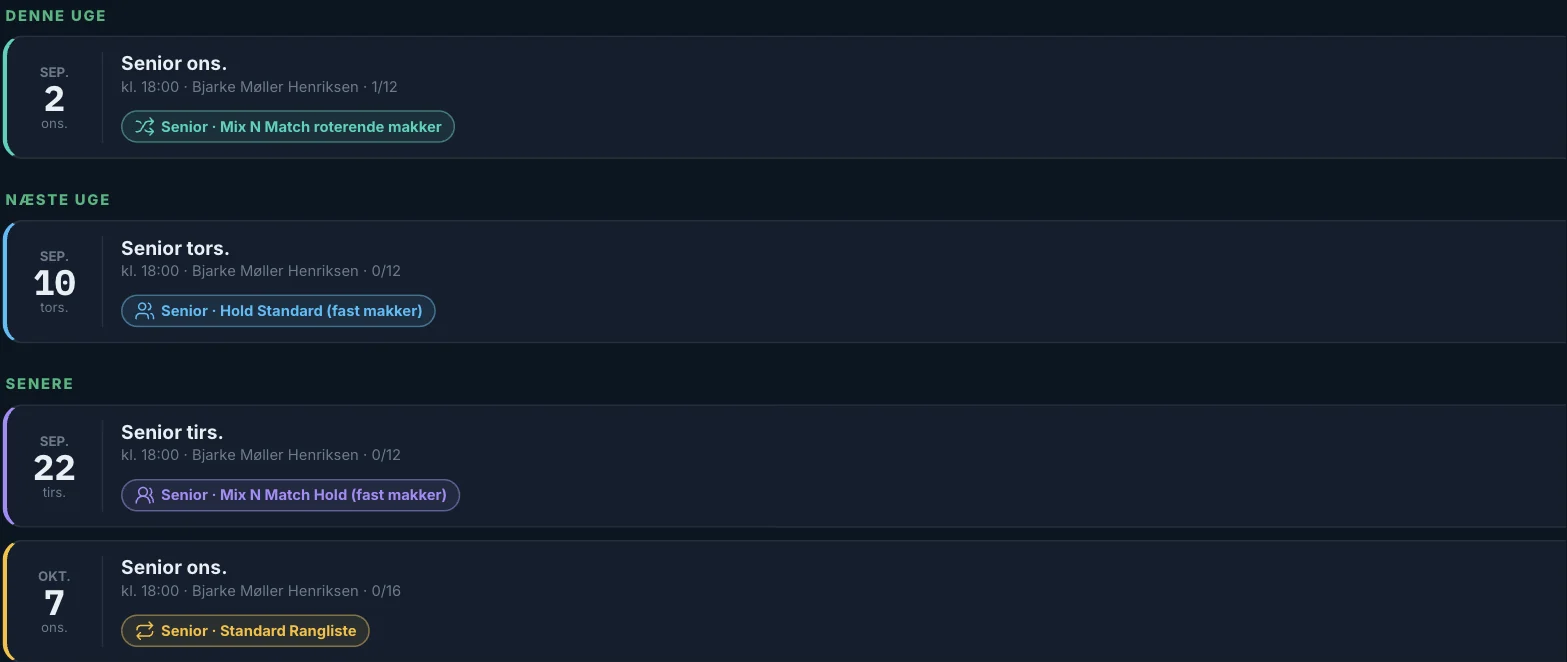
How to take part

Calendar & sign-ups

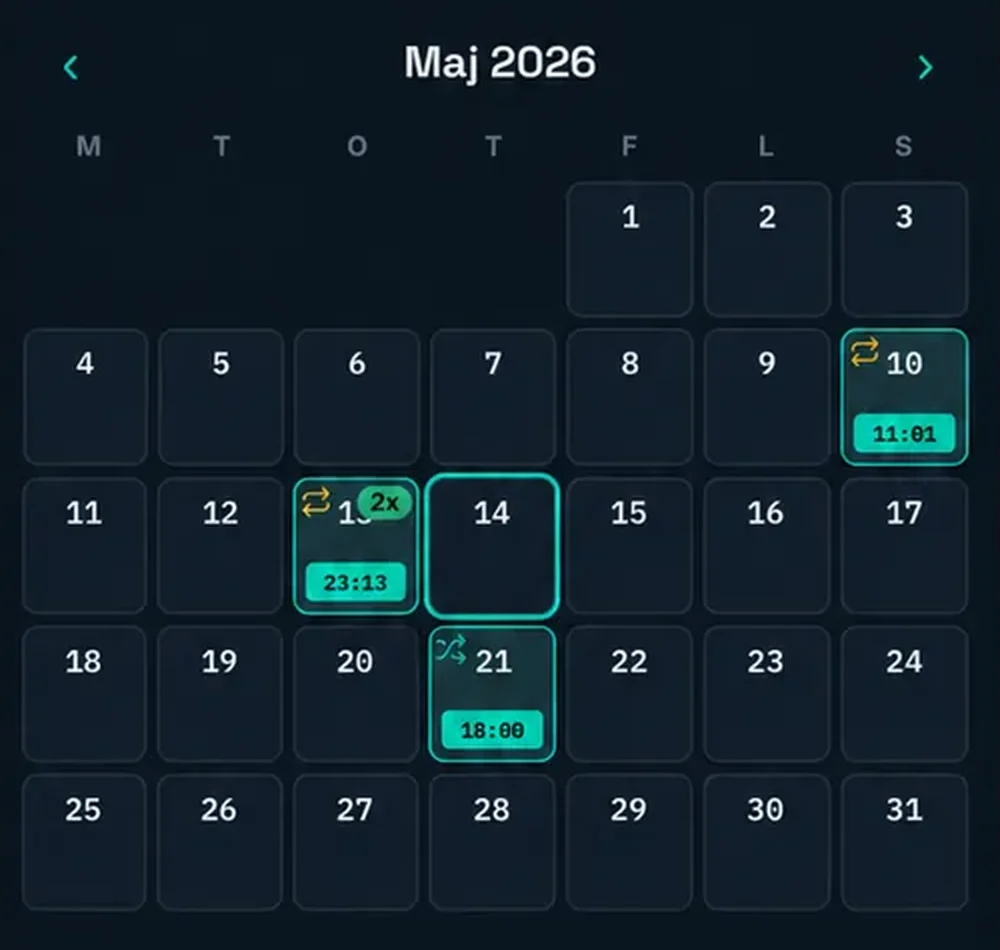
The captain plans tournaments in advance — they appear in the Calendar tab. As a player you can sign up straight from the calendar. You get a reminder 24 hours before any tournament you have signed up for.

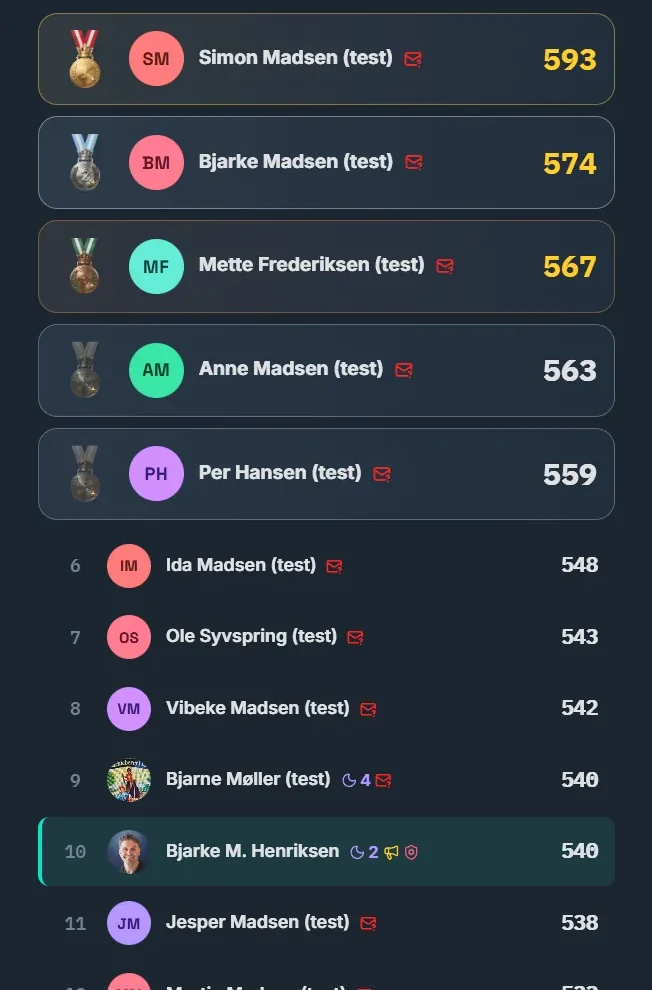
The leaderboard

Active and inactive players

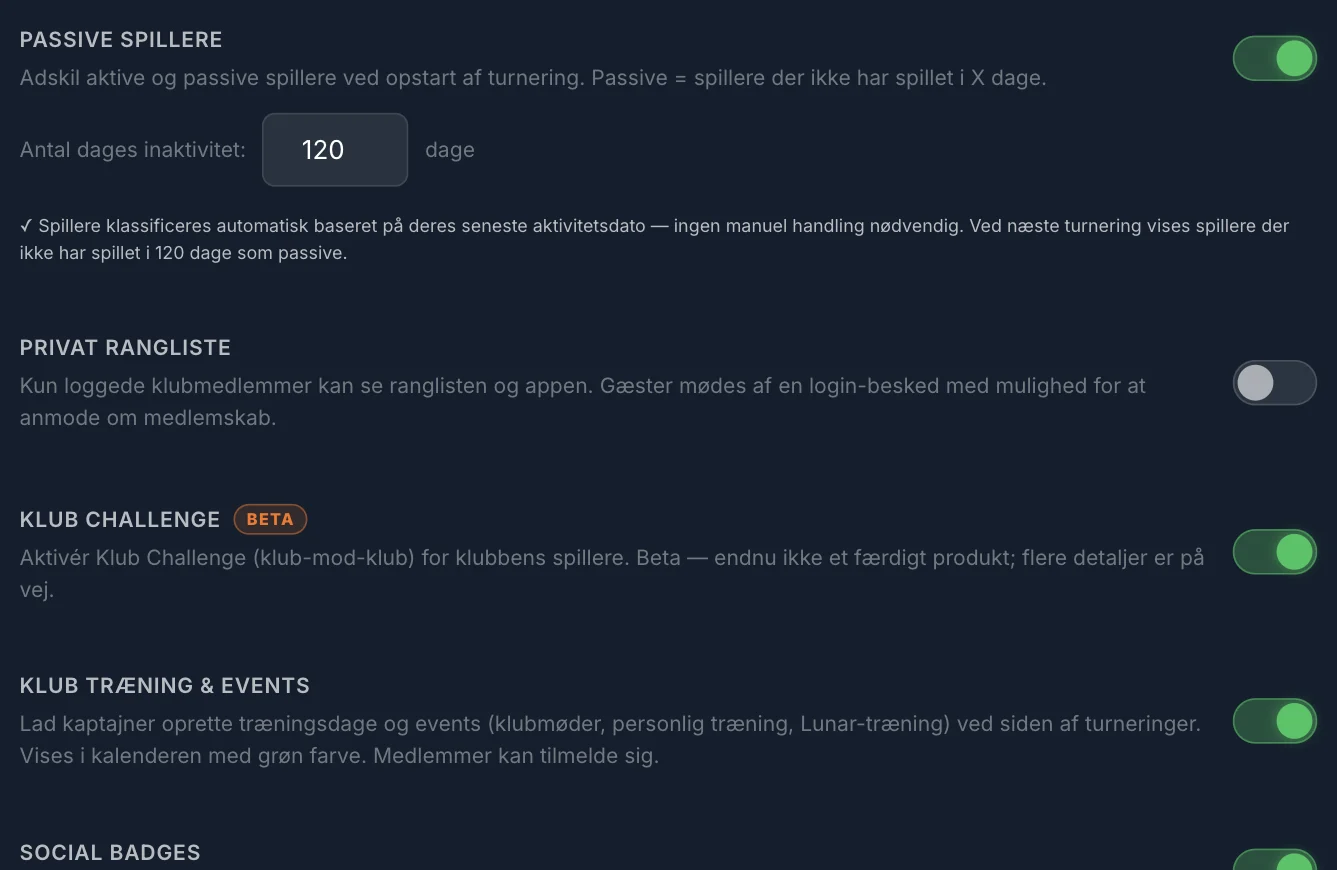
Players who have not played for 120 days are marked inactive automatically. Inactive players still appear on the leaderboard, but are kept apart from active players when new tournaments are set up. As soon as you play a match again, you count as active.

The 120 days is the default — each club can set its own threshold.

Calendar

Availability

Availability lets you mark the days and times you would like to play if the chance comes up — without having to create a post on the partner finder yourself.

Your markings are not a post, and they are not visible to anyone else. You appear to another player only at the moment they create a post matching your criteria — time, level and distance alike. From there they can send you a direct invitation, which you can accept or leave.

  1. 1

    Set your level

    Choose your own estimate of your padel level (1.0–7.0) under My account. It is the level that matches you to the right posts.

  2. 2

    Switch it on

    Go to Calendar → month view → turn the "Availability" switch on (yellow).

  3. 3

    Mark your times

    Tap a future day and give one or more time slots (up to four a day).

  4. 4

    Visible only to you

    Marked days get a yellow border and icon — visible only to you.

The level slider under My account. It has to be set before Availability can be used.

What happens then?

  • When another player creates a partner-finder post in a slot where you are available (and the post's level and area match you), you appear in their "matches your post" list.
  • That player can then invite you directly from the post.
  • Your markings are visible only to you — the only way anyone can reach you is by inviting you from a post.

Limits

  • A maximum of four slots a day.
  • Markings can only be set on future days (up to 90 days ahead).
  • You can clear a day again by tapping it and choosing "Clear day".

Availability is meant for players who do not want to go hunting for matches, but would happily join if one comes up at the right time.

Who runs the evening

Tournament captains

A designated captain runs the tournament day: starts it, enters the results (or approves the players' own entries) and closes it down. Captains are appointed by the club's administrator.

Full captain

Has full access — including player administration (creating, editing and seeing contact details) — and gets a silver badge that turns gold after 20 tournaments run.

Light captain

Creates and runs only their own tournaments, has no access to the player list or contact details, and keeps a bronze badge permanently.

The administrator decides which type each captain is.

Achievements

Medals, badges and club awards

The app awards badges for your achievements automatically, and the club votes on nine social awards. All 30 are described on their own page.

See every medal, badge and club vote →
Beyond the app's rules

The club's own rules

Every club has its own rules page in the app, written by the administrator. It is typically used for subscriptions and payment, house rules — clubhouse access, keys, sweeping the court — committee contacts and on-court etiquette.